A few important historical details that set the tone for the creation of the Zodiac Suite. These writings go best with the music, hence all of the annotated links. Two pre-Zodiac playlists offer an echo of Mary’s career up until 1944: W/ Andy Kirk & the ASCH recordings from 1944 (the 1st 20 or so recordings).
Mary moved to New York in 1941. She was born in Atlanta, in 1910, but grew up in Pittsburgh. In Pittsburgh she began performing at 6 years old and was dubbed “The Little Piano Girl” because of her skill. Her professional career started when she was 15. At 16, she married John Williams who was a saxophone player in Andy Kirk’s band. Eventually they moved to Memphis, Tn.
Mary initially followed her husband John to Oklahoma and Kansas City while he was working with Andy Kirk’s band The Twelve Clouds of Joy. She began to sit in with the band and then started contributing as a composer/arranger. Around 1929 she joined the band as a piano player. She made significant contributions to The Twelve Clouds of Joy as a performer and composer. Many of her songs were the most famous in the bands repertoire. Mary had a knack for creating memorable themes and worked out “systems” to create arrangements for the band. Her own descriptions of her process suggest that she was not a notating arranger, when she joined The Twelve Clouds of Joy, but instead an “ear” player who learned theory and notation during her tenure with the band. Instead Mary was a brilliant composer of melodies and themes who figured out ways to arrange and orchestrate for different ensembles. And she was an excellent pianist who was at home playing Stride, Boogie Woogie, Swing and Blues. Her career at that time seems to follow Ellington’s in that she was promoting herself as being a jazz composer. This was a feature of Ellington’s career, emulating the Classical model for composers, promoting his compositions in addition to his band leading. Ellington’s success in this area was pretty unique to him, most Jazz musicians are renowned more for their performing capabilities and solos over their compositions. Though Mary’s songs for Andy Kirk were popular (How many can you name?) I find she is generally remembered more for being a female jazz musician. I rarely find her compositions, musical innovations or playing is articulated in her tributes. An excellent expression of that frustrating reality is “Looking for Mary lou Williams” by Fabu Phillis Carter.
A rough divorce from John Williams and departure from the Kirk band in 1942 led her back to Pittsburgh. She married to Harold “Shorty” Baker in 1942, and also had a sextet with him and Art Blakey. Before they married Baker began working with Ellington and she joined him on tour initially and eventually wrote a few pieces for the Ellington Band. While the band continued to tour she returned to New York City and began to work on a solo career.
Mary is also a member of the great Pittsburgh piano tradition. With Earl Hines, Errol Garner and Billy Strayhorn. All of whom significantly contributed to Modern Jazz music as composers and piano players. Here we will also include Art Blakey who began as a piano player in Pittsburgh. Though Blakey became one of the most influential drummers, and band leaders, in Modern Jazz, he is also a critical element in many of the most important Modern Piano Trio recordings. He first joined Mary’s groups in Pittsburgh and again later on when he arrived in NYC.
The Modern Piano Trio is the piano, bass and drums trio. It is a critical aspect of the development of the suite, and Modern Jazz. Before about 1945 the primary piano trio was piano, bass and guitar, popularly heralded by The Nat King Cole Trio. The Nat King Cole Trio was one of the most popular bands in the world and its instrumentation was the typical piano trio at the time (though not always including vocals). To hear how this style of trio worked together listen to “Jumpin’ at Capitol”. Cole is a masterful pianist, whom influenced Williams, on this track, from 1943, you can hear some wonderful trio work and solos that evoke the pending transformation of the piano trio.
The precursors of the Modern Piano Trio, people who occasionally performed in a piano, bass, drums configuration, included Teddy Wilson and Count Basie. They were some of Cole’s piano contemporaries but more involved with big band swing at the time. Wilson recorded a few times in the piano, bass, drums configuration. Here he is in 1941 playing “Rosetta”. Count Basie is regarded as primarily performing with his big band, but there are continuous examples of a piano trio at work inside the big band (and also quartets with guitar) especially in the introductions and piano solo sections. Check out “Every Tub”, from 1938. At :30-:55 after Lester Young’s opening solo Basie works in this trio format. Mary and, her fellow Pittsburgh piano sibling, Errol Garner would push the new trio forward in the mid-40’s. Garner struck gold with his 1945 trio recordings including “Back Home Again in Indiana”. His horn-like right hand soloing is prominent here, something that Beboppers would take and perfect. Mary recorded in this trio format in 1936 on “Clean Pickin’”. Bud Powell would canonize that trio form in bebop. Here he is on “Bud’s Bubble” (also called “Crazeology”) from 1947. The Modern Piano Trio becomes almost ubiquitous after WWII with only a few notable exceptions like the Oscar Peterson Trio. Many of the current piano, bass, guitar trios feature a vocalist, similar to the Nat King Cole style trio. If we consider the time period and technology it may have been favored for being a quieter ensemble without the drums. Singers, guitarists and bassists all profiled in much different roles until the 1940’s based on microphones, amplification and projection. Mary was a student, and a teacher, of piano playing. You will find most of the primary figures involved in the development of the Piano, Bass and Drums trio are featured in the portraits within the suite.
The Zodiac Suite is one of the earliest Jazz Long Form Compositions, among the 1st thirteen recorded, depending on how you count them (and 10 of these are written by Ellington). The suite starts in this Modern Piano Trio configuration and switches into solos and duos, and is one of the longest works written for piano trio in Jazz. Many large scale compositions lean into large and unique instrumentations, something the Zodiac will do in successive iterations. The piano trio pops up infrequently as a vehicle for suites until later on in the 50’s. It’s important to note that Long Playing Records are still about 4 years away and only short recordings, about 3 minutes, were available. Artistic conception for a recorded long form musical work in 1944 was a much different endeavor.
By 1944 she had found a home for her own music at the Cafe Society. The first integrated (white) club in New York City. A club described as “The Right Place For the Wrong People” many of those “wrong people” are featured in the Zodiac portraits. The musicians she records with in 1944 are the same musicians that contribute by performance or inspiration to the Suite. The Rutgers Library has a simple and well annotated discography Mary Lou Williams: Recordings.
Also in 1944/45 she began “Mary Lou Williams’s Piano Workshop” a radio program on WNEW and she began recording with Moe Asch on the label that eventually would become Folkways Recordings. These three institutions were catalysts for the creation of the Zodiac Suite and Mary’s attempts at carving out a post-big band career for herself. Her radio opportunity seems to be one of the earliest instances of a black woman on the radio leading her own show. In fact this is an under-researched subject but based on this outline of Black radio firsts “The First Black Radio show (in America) Debuts” it seems this was a truly rare moment in history. I would speculate that Mary was both aware of that fact and that the creation of Zodiac Suite was an attempt to capitalize on the WNEW opportunity and grew from there.
““In 1945, while performing at the Cafe Society night club in New York,
Williams signed on with WNEW to do a weekly radio show called “Mary
Lou Williams’ Piano Workshop.” She had just released an album entitled,
“The Zodiac Suite.” which was a largely improvised composition, and
played versions of each of the astrological signs — one weekly on
WNEW— for twelve weeks.” WNEW, accessed 12/22/21
For more general information: “Golden Age of Black Radio – Part 1:The Early Years”
Socially she was mingling with the progenitors of Bebop who would begin getting attention after the War. But Bop was already percolating in Harlem and also within the big bands of the era. She developed relationships with the young Thelonious Monk, Bud Powell and Miles Davis, as well as the aforementioned Blakey. These relationships were described as a Motherly, or Sisterly, figure who held jam sessions in her home (*A wonderful NPR article about the relevance of Williams’ Harlem apartment by Tammy Kernodle) and fed musicians at all hours. The musical influence flowed in both directions. Mary added some “Bebop” elements to her music, served as a cypher for Benny Goodman’s interest in Bop and planned a trio of piano’s performance with Powell & Monk. Here is an example of her reciprocated influence like here in “Walking & Swinging” @ 1:34 and Thelonious Monk’s “Rhythmning”
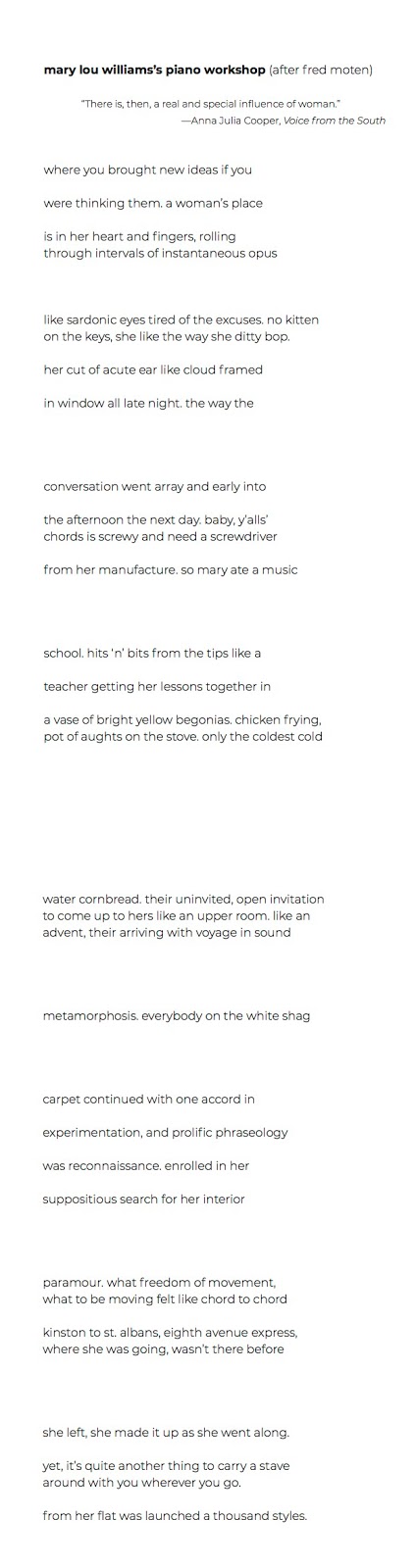
“Mary Lou Williams’ Piano Workshop” Poem by Makalani Bandele

 Found Sounds